

Snow Day
Or making peace with the long, dark season

Dear Reader,
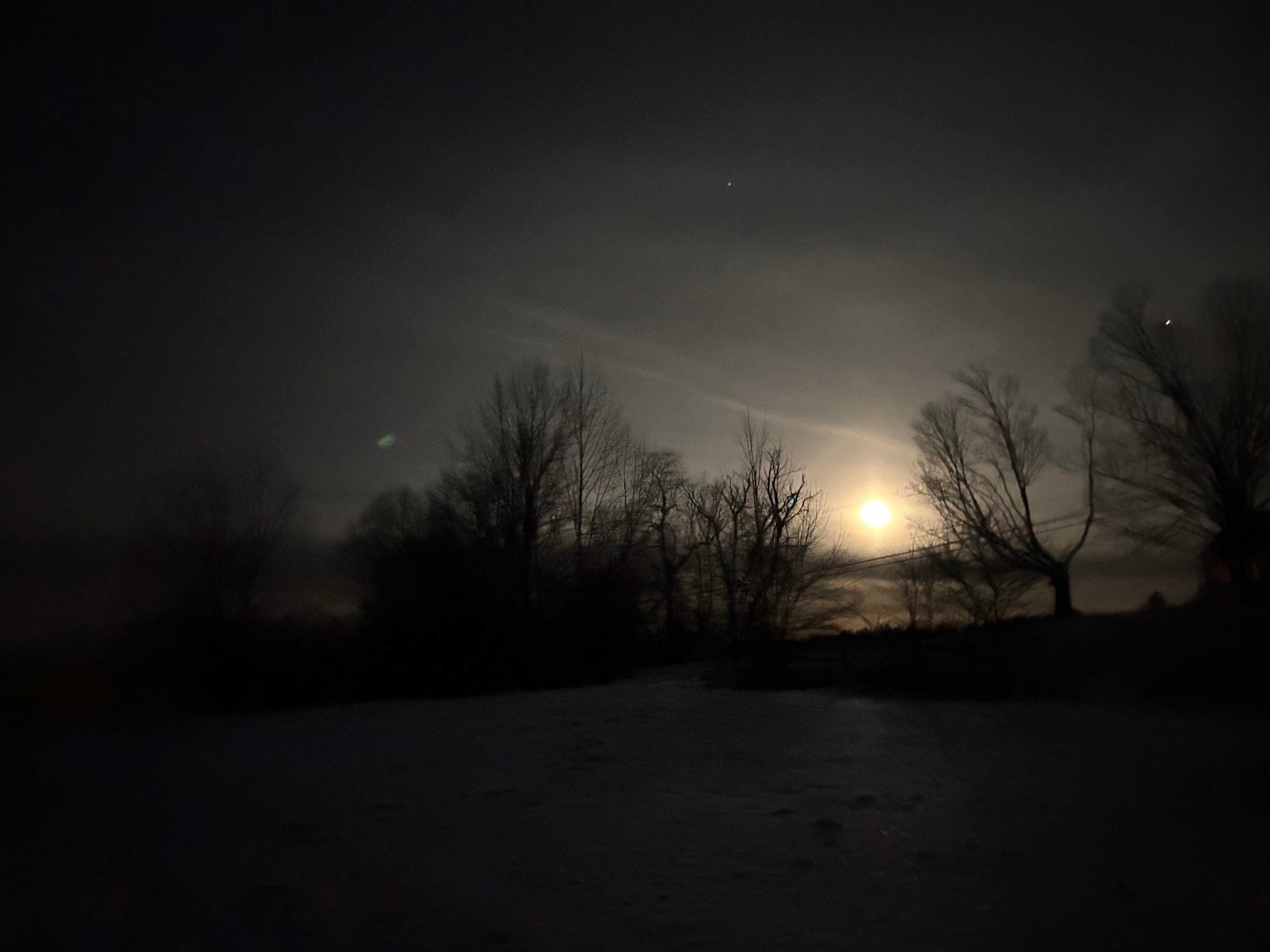
On Sunday evening, long after dark, the stillness in the air and the absence of activity permeate our little neighborhood. We trudge across the deep snow in our front yard, not wanting to pack down our front walk, grinding the snow into the concrete where it will be harder to remove tomorrow. The snow is up to (and over) our knees. The beagle is grateful for the path we make in the dark. He would be over his head otherwise.
Once onto the street, we walk in the middle, a car-wide strip cleared by the city plow, the snow falling heavily all around us. An expectant hush accompanies the stillness, broken abruptly by the roar of a snowblower. As we turn the corner, we see an older woman shoveling her steps, illuminated by the yellow glow of her porch light. The front door of the house opposite opens, and a man shouts to her, “Rosalee[1]—leave the snow alone. I’ll be there in a moment.” She waves an acknowledgment. Or maybe it is a signal of defeat, knowing she won’t get away with continuing to shovel.
I smile, feeling warm inside. No one ever noticed me shoveling the snow in Etna because our house was hidden from our neighbors. Last year, my husband was in Germany, visiting our oldest kid studying abroad, when he called my neighbor asking, “Would you mind plowing our driveway? I couldn’t get the snowblower to start, and Michelle is on her own.” My neighbor, bless him, was in our driveway before my husband had a chance to reach out to me. They might not see our needs, but good neighbors always come when called. I guess there’s a similar code here.
We round another corner of our cul-de-sac, now heading for home. Up a small hill, content to raise our faces to the falling snowflakes, companionable and silent. The dogs now lead the way on the semi-plowed street. In front of our house, we encounter our neighbor from across the street, who, like me, grew up in this neighborhood. We recall winters past, in the 1970s, when plowed snow in driveways would accumulate, piled high into mountains perfect for sledding. The snow hasn’t accumulated like that this winter, but I remember winters in Etna when my kids played on the snow mountains in our driveway. In the backyard, they would pack snow smooth and thick on a piece of plywood, creating a 4-foot-high steep ascent from the bench on the deck to the sloping yard, barrelling towards the thick-iced pond on sleds, giggles and shouts of delight billowing behind them like a scarf.
Do I miss those days? Those snow days that weren’t snow days because we homeschooled? When the roads were clear the next day, we would abandon our books then and ski. The actual snow days were spent “at school,” but they were never long. With the extra motivation, the kids flew through their work in record time and headed outside.
I am in a different place and time—a different season of life. The Gift from the Sea by Anne Morrow Lindbergh[2] spikes from my memory, a book I read when I was deep in the trenches of work combined with homeschooling. Lindbergh captures this time for me. Her description of motherhood, family life, community (and my insertion of work life) holds true for me, even all these years later:
To be a woman is to have interests and duties, raying out in all directions from the central mother-core, like spokes from the hub of a wheel. The pattern of our lives is essentially circular. We must be open to all points of the compass: husband, children, friends, home, community; stretched out, exposed, sensitive like a spider’s web to each breeze that blows, to each call that comes.
She was a woman trying to make sense of her place in the world while raising children. Actually, I think of her not so much as searching for her place, but for herself. Aren’t we all?
The ache, the pull, the weight of her words—all are poignant to me.
They capture this tug: the juxtaposition of the nostalgia for my children’s childhood and our home by the pond against the clarity and simplicity of my life in the suburbs, an empty nest when the kids are at college, from which my husband is absent during the week. I am alone except for my dogs. Here, my days stretch long, but they bend to my will, my rhythm, my patterns, my whims. Do I really miss the full days, teaching my own children with a foreboding, uncertain future? A question asked by everyone that I tried to scuttle from my brain during those years, “Are you really, truly doing the right thing?” Or am I nostalgic for the holograph of the sled pulsing full speed down a child-made hill toward a future that I now know is certain, that is bright?
I shake this light cloak of malaise, hoping to dislodge its silklike weight that has settled, carelessly draped, over my shoulders. It flutters but remains with me. I reach for my dog’s leash and take a spin around the block. The cold refreshes me, as always, but I am not yet ready to fully focus on the index waiting for me, a treatise on biotechnology. I need to approach this project—a heavy, weighted topic—with a lightness to produce an effective index. I need to ensure no biases creep into the index, whether influenced from the author’s words or my state of mind. My openness allows me to focus on the reader—to hold their intentions front and center, rather than the author’s.
Even though I read and distill countless books for a living, I still reach for them for guidance. In my office, I turn to my bookshelves, perusing the titles until I settle on Julia Cameron’s latest—The Daily Artist’s Way. The malaise becomes a mist, dissipating as I slide it off the shelf. I bought this book over Thanksgiving weekend in a seaside town in North Carolina. It jumped out at me then, a stack of red-spined books on a lower table, just like it stood out for me at this moment, beckoning me to hold it, open it, and open up myself.
This book’s structure pleases the indexer in me. It can be worked front to back or opened at random to let serendipity play a part in finding the starting point. Yet, the designer of the book also discreetly shoehorned an index between where Cameron, the author, discusses the tools of a creative life (Morning Pages, Artist Dates, Walking, and Writing for Guidance[3]) and meditation entries. Instead of thumbing through the book’s pages or opening to a page at random, I deliberately go to the Topic Index (a delightful name) to peruse the topics. I don’t know what I’m hoping to find on these four 5 x 8 pages. Do I seek a meditation on challenges? No. I turn the page and look at the F’s: fear, failure. My eyes dart to the opposite page, and the number of entries under perfectionism surprises me. (10!) No—that’s not what I’m looking for. On the following page, “the vein of gold” sounds intriguing, but not for today. I flip back a couple of pages. Under the G’s I find what I’m looking for: grounding with two entries: 36 and 273. I turn to meditation 36 and read:
Grounding can be found through mindful practices—whether deep breathing, meditation, or walks in nature. These actions strengthen your connection to yourself…
The accompanying quote from Morgan Harper Nichols reminds the reader that slowing down and realizing there’s more to see is indeed the practice of peace.
I arrange my limbs in a comfortable position on my chair. I close my eyes. I breathe deeply, the box breath—breathe in 1-2-3-4, hold 1-2-3-4, breathe out 1-2-3-4, rest 1-2-3-4. I repeat the cycle four times. Jamie Tartt trots over to rest his head on my leg before tilting his eyes towards mine. I am grounded. We are grounded.
Now I can delve into my indexing project. I square my shoulders, click my mouse to revive my monitor, and open my index files. My fingers are poised, ready to fly across the keyboard. I do one more box breath, then begin my work.
Reader—this is a long letter, written during this long, dark season. The cold can’t help but creep into my mind and my work since it settles around me tightly every day. Lightness and warmth are around the corner, but not near enough to touch yet. Walking, breathing, and acknowledging the cold to find the moments of peace—of sparkle—can shift the shroud of winter for me.
How do you make peace with this season? Do you find yourself outside, in nature? Or do you prefer indoor meditation—whether that’s journaling, reading, or even simply breathing? Do you find there’s more to see when you slow down?
Until next time,
Michelle
[1] Name changed to protect the innocent :)
[2] Yes. She was married to Charles Lindbergh.
[3] Cameron’s homepage on her website offers a brief introduction to these tools, too. Or listen to this interview with Cameron on The Art Angle podcast. Jacqueline Fisch and I talk about these tools—and how we use them in our businesses—on the Business Book Exchange podcast.
There’s definitely so much to see when we slow down ❤️❤️❤️ I love these glimpses into your writing and indexing life. Especially hearing about how you navigate a book 📖